“The Moost Happi” Medal: The Most Complete Contemporary Image of Anne Boleyn
When it came to choosing an image of Anne Boleyn for a permanent public memorial in the parish church of St Peter’s at Hever—where Anne herself once worshipped—there was only one image that could meet the demands of authenticity, authority, and integrity: the “Moost Happi” medal of 1534. Though other likenesses of Anne survive from her lifetime, none match the medal in terms of provenance, symbolism, and its intimate connection to Anne herself. It is, quite simply, the closest we come to seeing Anne Boleyn as she wished to be seen.
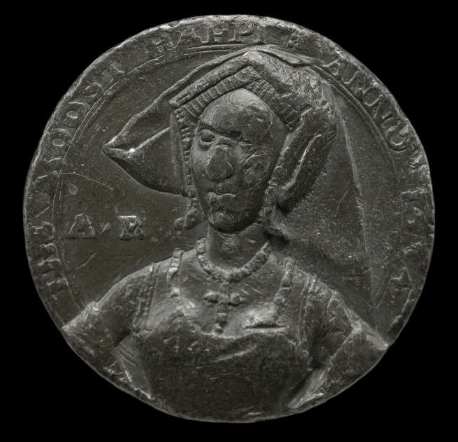
The medal, now housed in the British Museum, is a damaged prototype cast in lead and measures 38mm in diameter. It bears Anne’s crowned bust, the inscription “A.R.” for Anna Regina, and her personal motto: “THE MOOST HAPPI.” These three elements—the date (1534), the title, and the motto—confirm that the medal was made not only during Anne’s queenship, but also with her participation or endorsement. This wasn’t a passive likeness created without her involvement. It was a royal image with all the visual vocabulary of power, legitimacy, and self-representation.
It is almost certain that the medal was commissioned for Anne. Eric Ives suggested that it may have been produced in anticipation of a male heir, as Anne was known to be pregnant in the spring of 1534. That no finished copies survive—only this single lead prototype—suggests the project may have been halted due to Anne’s miscarriage later that year. But this very uniqueness adds to its value. This isn’t an image produced for mass circulation or posthumous commemoration. It is a personal and public projection of queenship, suspended in time at the moment Anne stood at the height of her power.
The medal’s damage has sometimes been cited as a reason to dismiss its usefulness. One eye has been flattened, the nose is worn, and the surface bears compression marks. But modern reconstruction work, most notably by sculptor Lucy Churchill, has helped to recover the original form of the likeness. Churchill’s reconstruction draws from the medal’s contours, earlier undamaged sketches, and analysis of period jewels and costume. It restores the regal presence intended by the original artist: Anne with her long, oval face, deep-set eyes, full lips, and a distinctive, slightly pointed chin.
What truly sets the “Moost Happi” medal apart is not just its date or craftsmanship, but what it tells us about Anne’s self-image. It is the only known contemporary likeness produced under her direction, during her reign as queen, and carrying her chosen motto. Anne wears English dress rather than the French hood she popularised at court—perhaps a strategic visual alignment with native traditions. She is adorned with royal jewels, including the consort’s necklace, which was later worn by Jane Seymour and appears in Holbein’s portraits of Henry’s subsequent wives. Her clothing, headdress, and the presence of the motto all speak to a carefully curated presentation of power and legitimacy.
Other contemporary images of Anne survive, but all come with caveats. The illumination of Anne disguised as Philippa of Hainault in the Black Book of the Garter is rich with allegorical meaning but lacks detail and was intended more as courtly symbolism than portraiture. The coronation banquet sketch offers a schematic view of Anne at her most ceremonial but lacks any individualised features. The woodcut in Wynkyn de Worde’s coronation pamphlet provides a rare glimpse of Anne in a French hood, but its crudeness and propagandistic nature limit its usefulness as a likeness.
Even the Holbein sketches—much discussed and re-evaluated in recent years—are not beyond doubt. One, identified as Anne by Sir John Cheke and now held at Windsor, is likely her most intimate image. But even here, debate continues over the identity of the sitter, the context of the sketch, and whether the portrait was ever completed. While this image may give us the richest potential insight into Anne’s private face, it does not carry the same clear stamp of royal presentation or public intent.
This is what makes the “Moost Happi” medal so significant—and why it is the ideal image to anchor a new memorial in Hever’s parish church. It is not a retrospective interpretation. It is not an allegory. It is not a posthumous attempt to beautify, vilify, or romanticise Anne Boleyn. It was created in her lifetime, almost certainly with her approval, for the specific purpose of showing her as queen.
In the absence of any surviving tomb or state portrait, the medal is Anne’s own visual legacy. It shows us not how later generations imagined her, but how she wanted to be remembered. By choosing this image for the new memorial—positioned in the church that Anne knew intimately—we are honouring her on her own terms.
It is fitting that beyond the walls of the Tower of London, where Anne’s life so violently ended, there will now be a publicly accessible memorial that reflects her status, ambition, and self-presentation as England’s anointed queen. The “Moost Happi” medal allows us to meet Anne Boleyn not as victim or legend, but as she once was: the crowned queen of England, proud, powerful, and very much present in her own narrative.
 Queen Anne Boleyn Memorial