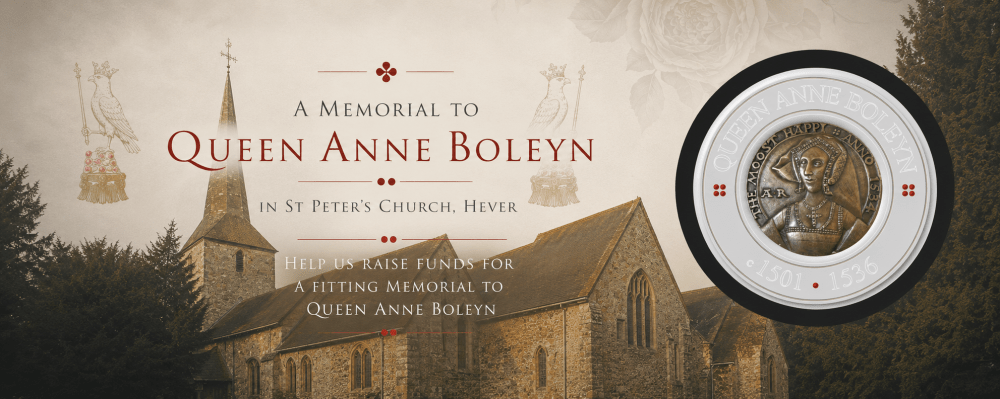
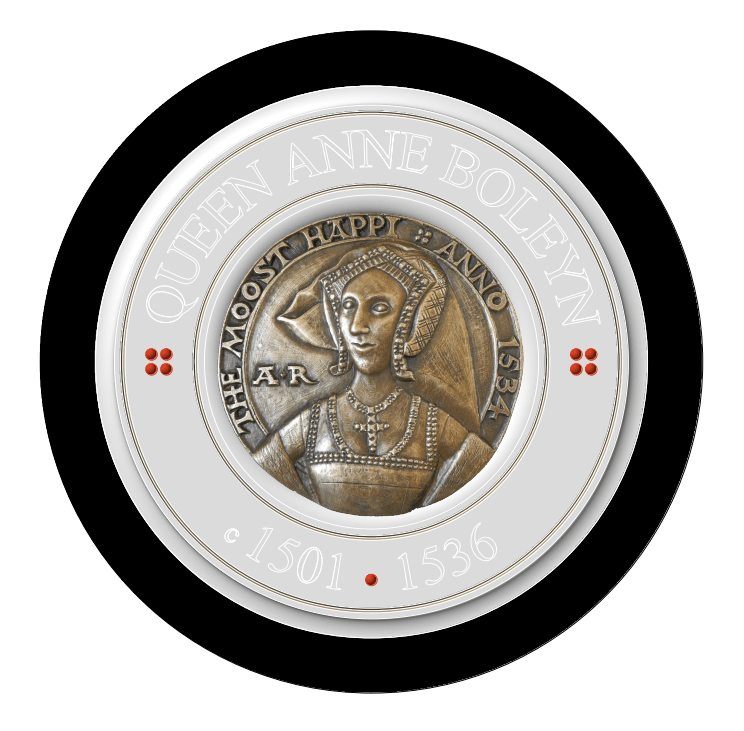
We need your help to raise £85,500-00 to create and install a permanent memorial to Queen Anne Boleyn in St Peter’s Church, Hever.
Why Memorialise Anne at St Peter’s Church, Hever?
Queen Anne Boleyn is a central figure in one of the most transformative periods in English history and was the mother of one of the greatest Queens, Elizabeth I.
When she was executed in 1536, Anne was buried hastily and without ceremony in the Chapel of St Peter ad Vincula at the Tower of London. According to some sources, her body may even have been placed in an old arrow chest. Today, a simple flagstone marked “Queen Anne Boleyn 1536” offers a quiet remembrance, but historians remain unsure whether her remains lie beneath it. That stone was not laid until the 19th century, after Queen Victoria approved an excavation of the chapel during renovations to the floor in 1876. Anne Boleyn’s remains were believed to have been identified during this excavation, but the attribution rested largely on the now-discredited practice of phrenology, which drew conclusions from the shape of the skull. Consequently, historians remain sceptical that the remains were Anne’s.
We believe that Anne Boleyn deserves better.
Though we cannot know where she lies, we can give her a memorial worthy of her role in our national story. And there is no place more fitting than Hever.
Anne spent much of her formative years at Hever Castle, which had been the home of her great-grandfather, Geoffrey Boleyn, purchased in 1462. Just steps away stands the parish church of St Peter, where her family worshipped and where her own memorial will be placed in the Bullen Chapel. It’s the same chancel that holds the modest brass memorial of her infant brother Henry and the richly decorated tomb of her father, Thomas Bullen, with its nationally significant memorial brass. Anne will become the third member of her family honoured here, in the church where she worshipped.
Recent research adds even greater weight to this setting. Architectural historian Dr Simon Thurley has shown that Anne spent time at Hever as an adult, from around 1524 to 1529. These were crucial years. Anne often chose to reside at Hever as she awaited the outcome of Henry VIII’s “Great Matter,” the long process of ending his marriage to Catherine of Aragon and eventually breaking with the Church of Rome. Hever wasn’t just her home; it was a place of political intrigue and theological development. As a follower of William Tyndale’s works, Anne was an active participant in the religious and political upheaval which facilitated her rise. Bishops came to Hever to update her in person. The rector of Hever, John Barlow, acted as a courier between Anne and the King, and went on an embassy to Rome. Anne was not a bystander – she was a key figure in the events that gave rise to the English Reformation.
The Diocese of Rochester has already recognised Anne’s importance in its new Reformation triptych at Rochester Cathedral. Now, this memorial at Hever offers us a chance to honour her in the very church where her story began and where her family rests.
We invite you to be part of this long-overdue act of remembrance. Help us give Queen Anne Boleyn the memorial she has always deserved.

Your Donation
Your donation will help fund the creation and installation of the memorial. Should any surplus funds remain following its completion and installation, they will be dedicated to the upkeep and maintenance of St Peter’s Church, Hever.

